ASTC Forum Held In Charleston, SC

On September 19 and 20, ASTC members convened for our annual Forum in Charleston, South Carolina. Home of the Spoleto Festival, this Forum location provided an opportunity for our members to learn how Charleston’s venues have been shaped by hosting the internationally renowned performing arts festival each May since 1977. Founded by the composer Gian Carlo Menotti, the Festival is a sister to its counterpart in Spoleto, Italy. Co-Chair of the Forum, Kevin Greene, ASTC, who worked previously as a technical coordinator for the Spoleto Festival, arranged venue tours and discussions with the venue operators.
Our home during this Forum was the historic Frances Marion Hotel. We kicked off our activities with introductions of members and guests over a buffet breakfast, leading to tours and post-tour discussions of the following venues:
Dock Street Theatre: This venue, on the National Register of Historic Places, opened originally in 1736 and is considered “the first building built specifically for performing arts in the United States.” Its current structure was constructed on the site of the Planters Hotel in 1809, and the theatre was rebuilt within the shell of the hotel as a WPA project in the 1930s. Our members toured the backstage and front-of house areas, including technical booths, dressing rooms, and lobbies. The venue hosts chamber music, opera, and theatre during the Spoleto Festival. The latest renovation of the Dock Street was accomplished in 2010, with a design team including Evans and Schmidt Architects and Theatre Consultants Collaborative.
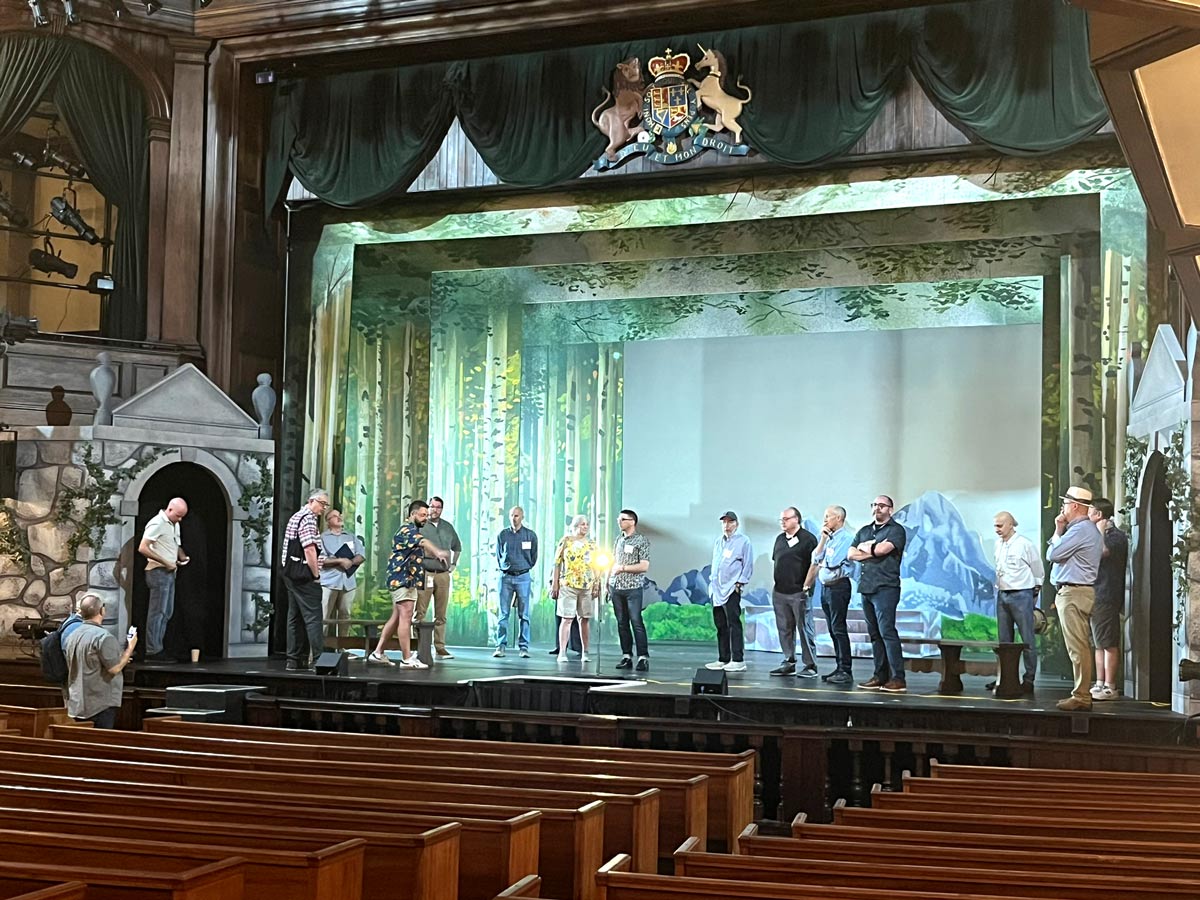
The hills are alive with the sound of consultants. ASTC members explore the stage of the Dock Street Theatre, which was set up for rehearsals of The Sound of Music. (Photo by author)
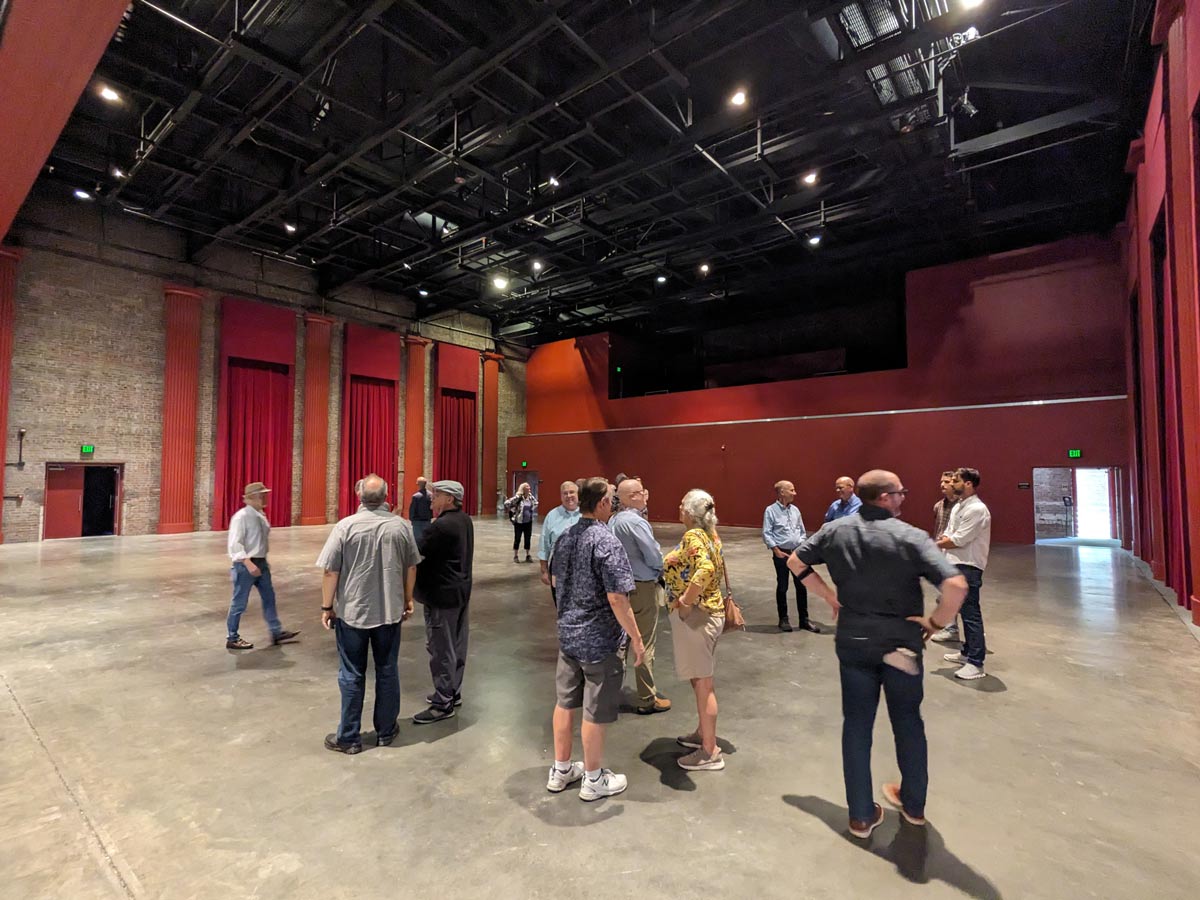
Festival Hall, in its open state, awaits the next group to bring in audience risers, scenery, or banquet tables. The opportunities are endless! (Photo by Bob Jenista)
We next toured Festival Hall, a flexible performance and event space in the downtown Harleston Village neighborhood. This 14,000-square foot facility features a catwalk grid system designed by the venue’s technical staff, allowing support for theatrical equipment in any configuration of the hall. The venue is home to major musical events during the Festival, and is well-used throughout the year for weddings, parties, fundraisers, meetings, and other community events.
At Charleston Gaillard Center, Joshua Dachs, ASTC, led an extensive tour of the performing arts center, which opened in 1968. The center was significantly renovated from 2012-2015 by a team which included architect David M. Schwarz and theatre consultant Fisher Dachs Associates. The center is anchored by the 1800-seat Martha and John M. Rivers Performance Hall. Home of the Charleston Symphony, the Gaillard is integral to the Festival. The Center also includes a 16,000-square foot banquet hall and houses City of Charleston offices.
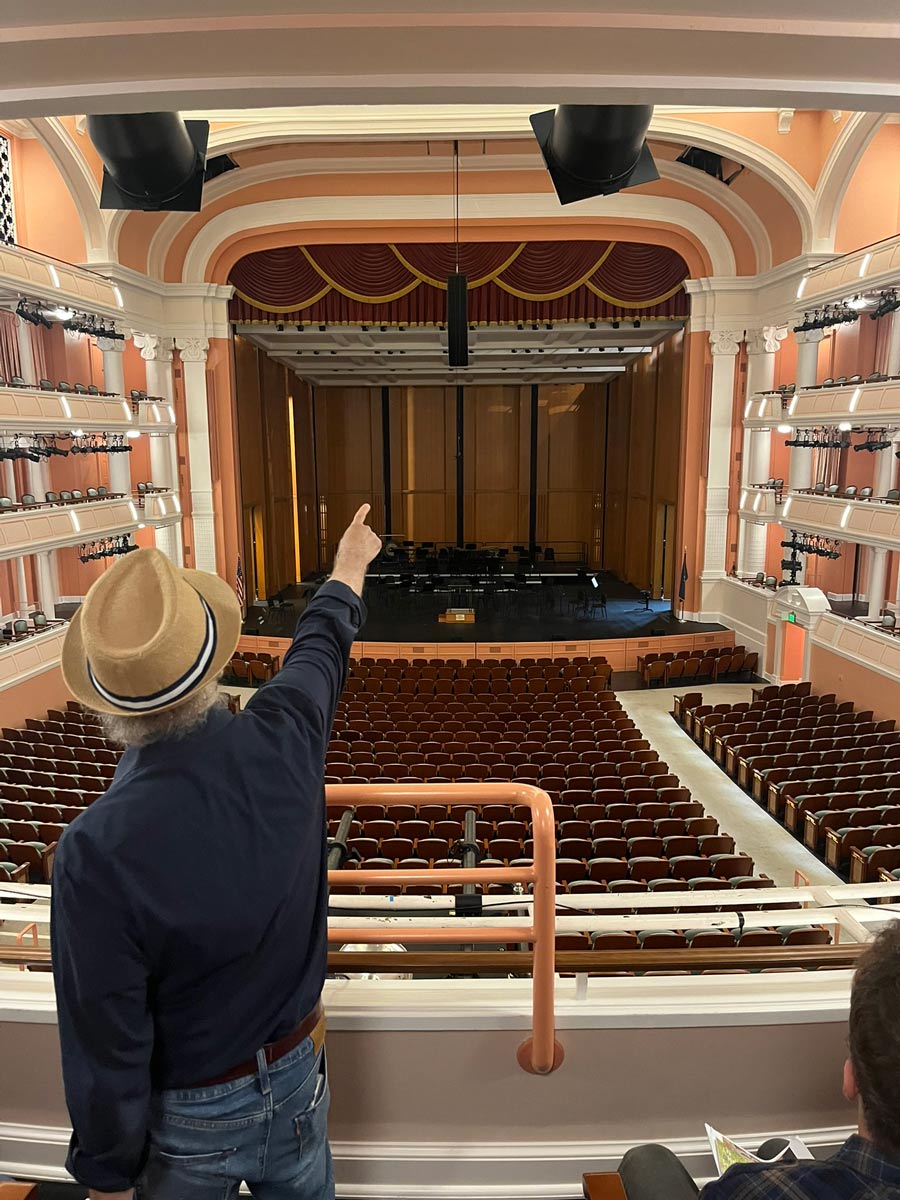
Joshua Dachs, ASTC, discusses the concert shell deployed at the time in the Martha and John M. Rivers Performance Hall at the Gaillard Center. (Photo by author)

STC members make an impromptu visit to the former Garden Theatre, which has been converted into retail space by Urban Outfitters. The store retains much of the original theatre’s infrastructure including the balcony, proscenium arch, and gridiron over the stage. (Photo by Bob Jenista)
As we walked to the scheduled tours, we took some impromptu detours to see other sites, including Cistern Yard at the College of Charleston, which hosts outdoor acts during the Spoleto Festival, and a jaunt into Urban Outfitters on King Street, which was formerly the vaudeville age Garden Theatre. (No word as to whether any members picked up some dapper duds during that side trip.) After each tour our members engaged in discussions to evaluate what we saw. We were joined by Dexter Foxworth, COO of the Spoleto Festival, to answer our questions and share his experiences.
In addition to our tours, venue discussions, and our business meeting, Forum Co-Chair Robert Long, FASTC, facilitated the town hall that has become a fixture on our Forum agenda. Members drew topics out of a hat for short, engaging talks on prompts such as “Things that went wrong”, “Can AI design theatres” (short answer: “no”), “Grid Irons”, “Integrating Digital Scenery”, etc. Individual members and our code committee led discussions on construction management issues, proposed changes to NFPA and IBC 410, and loading paths.
Dinners each evening provided members with the opportunity to relax and socialize. We dined at Tempest on Market Street for our opening dinner and The Greenhouse for our closing reception and dinner. The ASTC meets each fall at locations all over North America to enhance our knowledge, strengthen our practice and maintain our professional connections.
By Heather McAvoy, ASTC
Disclaimer: Any views or opinions expressed in this article are solely those of the author and do not necessarily represent those of the American Society of Theatre Consultants. This article is for general information only and should not be substituted for specific advice from a Theatre Consultant, Code Consultant, or Design Professional, and may not be suitable for all situations nor in all locations.