
Did You Know – Get with the Program?

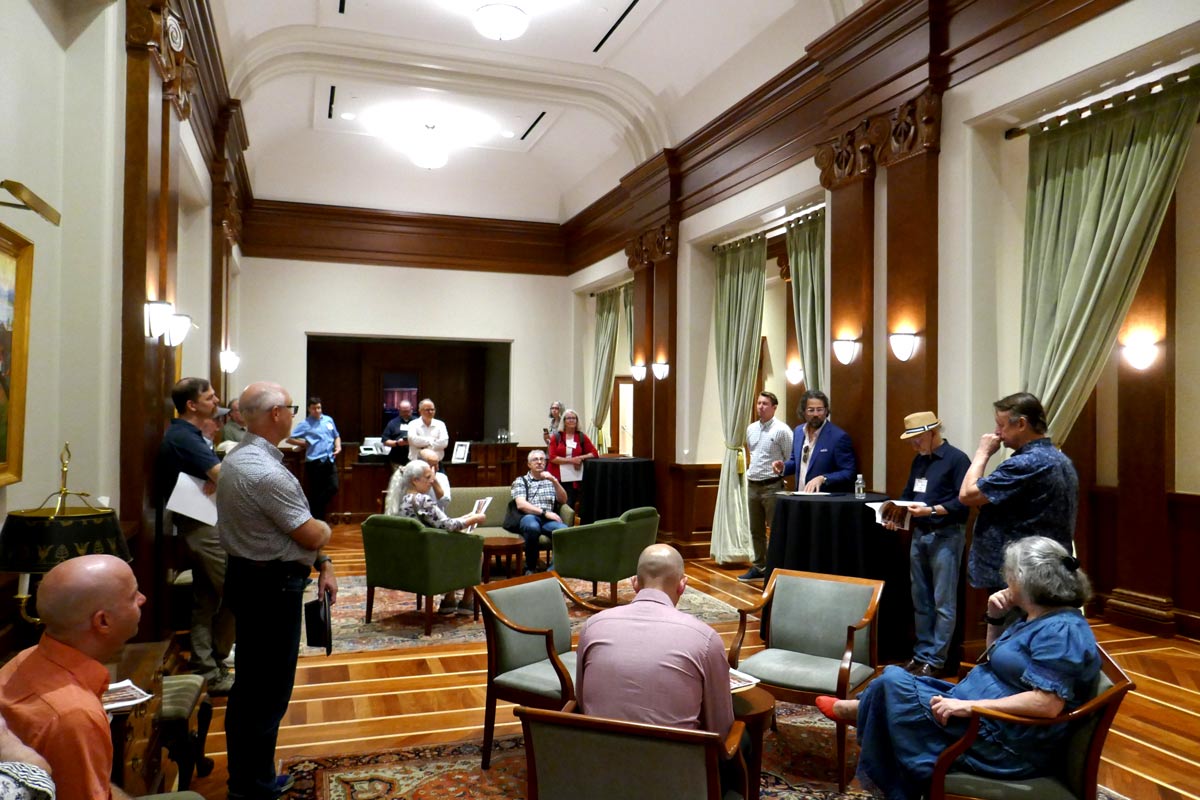
ASTC members tour the Donor Lounge at Galliard Center, Charleston, SC as part of their Fall Forum meeting. This is important program space that should be close to the performance venue and may require additional spatial requirements like bar storage or catering support. (Photo by author)
The design of any building involves many people with different roles and experiences. There is a design team of architects and consultants who work on buildings every day. More important are the administrators, users, and other key stakeholders who will eventually work in or around the building being designed. Some of the people representing the user organization(s) may have been involved in a design project before, while for others it may be a novel experience. Many words will be thrown around, and it is important to make sure everyone understands some of those terms may have different meanings in different contexts. One of those terms is “program.”
In a construction project, a “space program” or “functional program” is a critical piece of information defining the sizes and perhaps the basic arrangement of all of the spaces in a building. It will frequently be shortened to the “program.” The architect and theatre planner will be very interested in working out the sizes and critical features of each space – be it the theatre, box office, scene shop or dressing room. Knowing the sizes of these rooms starts to form a sense of the overall volume of a building. Those critical spaces or rooms are often called “program space.” The goal is to maximize that space while being efficient in the overall building size (and cost).
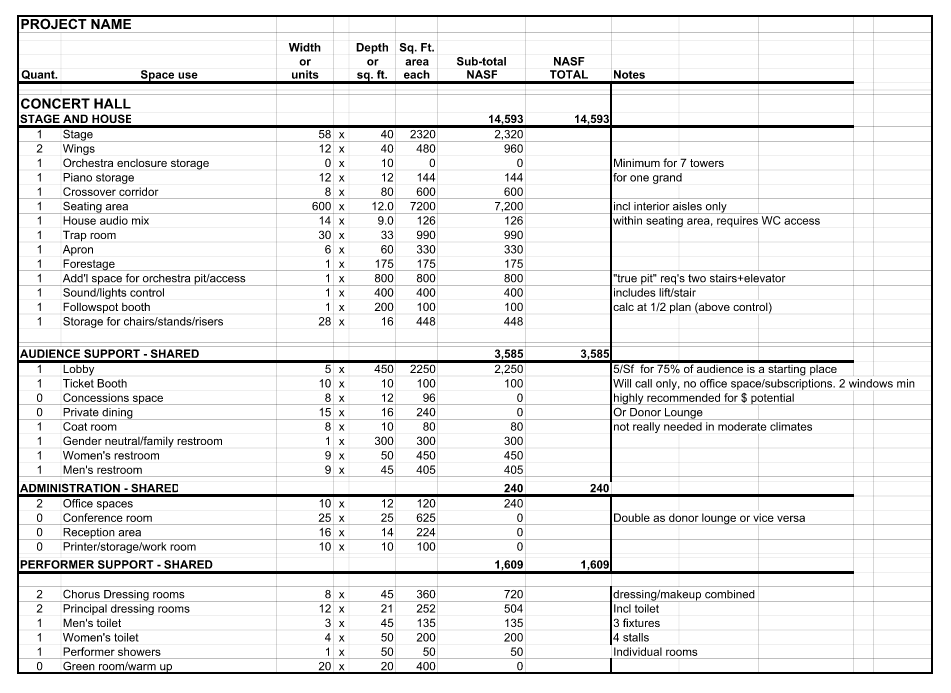
Sample of a portion of space program. The spaces and sizes of those spaces can vary widely based on the specific needs of the using organizations. Courtesy of Rose Steele, ASTC. (Click to enlarge.)
A program is also the curriculum for a department, or a system of steps to accomplish a goal. The people who schedule shows or decide on the shows in a venue might consider that work to be programming. Others might think of program as the order of an event or even the physical booklet that describes what will happen during a play or ceremony. Of course, some people hear “program” and may think of the applications on their computers. Each of these can be considered an ordered plan or roadmap. The space program we are talking about is similar – it is a foundational document developed to help the design team to stay on course while developing the building. Sadly, the space program has nothing to do with NASA (but it is a program too!).
Once a design team has developed the “program spaces” where things happen, they will know the total net program area. That’s not enough because not included are other areas like circulation, mechanical spaces, wall thicknesses, etc. (See “How Much? The Grossly Larger Space” and “The Net-to-Gross Multiplier is Truly Gross”.) A bit of math is then used to calculate how much extra space is needed to construct the building and make it functional. That gross square footage and some historical data can start to bring construction costs into focus.
So, get with the program and make sure everyone knows what those buzz words mean. It can help everyone be more focused and work in the same direction from the beginning.
By Paul Sanow, ASTC
Disclaimer: Any views or opinions expressed in this article are solely those of the author and do not necessarily represent those of the American Society of Theatre Consultants. This article is for general information only and should not be substituted for specific advice from a Theatre Consultant, Code Consultant, or Design Professional, and may not be suitable for all situations nor in all locations.