

Why Terminate DMX Cables?

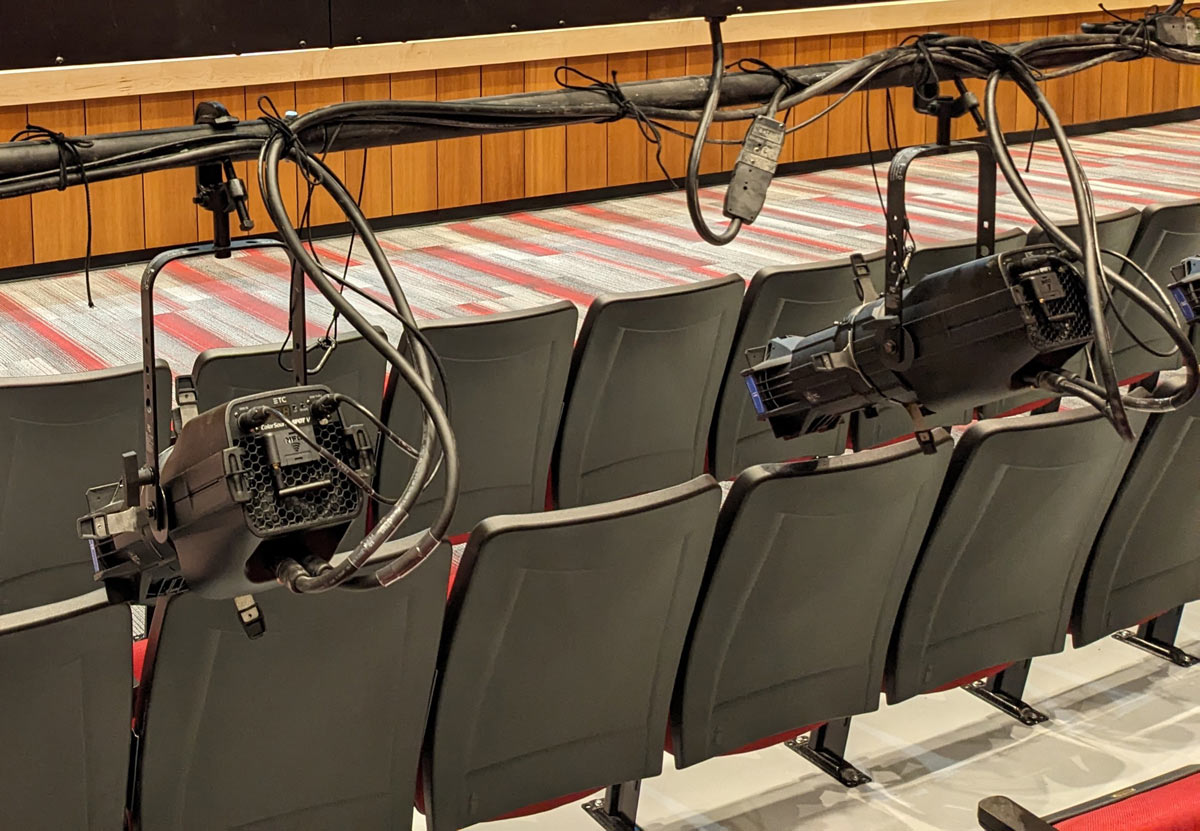
DMX control cables are used here to daisy-chain into one fixture and out into the next. The last fixture in the line will need a resistor plug to prevent end of line reflections. (Photo by Bob Jenista)
Those of us with even a passing involvement in performance lighting systems and DMX wiring have heard the edict “you must terminate the end of a DMX cable run.” But why is this? The short and simple answer, which is also the most technically correct, is that a DMX signal cable run may exhibit transmission line characteristics.
You can read the ANSI standard E1.11 – 2024 and related standards from the ESTA Technical Standards Program. Also perhaps an easier read for installers and users is: Recommended Practice for DMX512 by Adam Bennette.
Terminating the end of a signal transmission line is different from what a contractor thinks of as terminating a cable. To an electrical or low voltage contractor, terminating a cable means connecting the wires to some device; be it a receptacle, a jack, a breaker, or some other piece of equipment. On the other hand, terminating a signal transmission line means connecting an impedance across the signal wires. This impedance must be the same as the characteristic impedance of the cable and must be located at the end of the cable run. For DMX this means a 120 Ω resistor placed across the DATA + and DATA –wires at the last device.
Warning: we are getting technical for a moment. Hang with us.
While the idea of a “signal transmission line” may be new to the reader, signal transmission line theory began over a hundred years ago. The earliest development dates to Dr. Wildman Whitehouse and telegraph lines in the US circa 1850; which was expanded upon by William Thomson (later Lord Kelvin) in a more advanced theory used for the first trans-Atlantic cables in 1858; and was mathematically completed and formalized by Oliver Heaviside with the telegrapher’s equations of 1876.
Transmission line theory is not exotic or limited to specialized usage. Almost all “signal” type cables we encounter day to day are treated as signal transmission lines; Ethernet, HDMI, DisplayPort, all variants of USB, and every antenna. Even on a small scale the design of circuit boards must consider transmission line behavior. It is everywhere.
Transmission line theory is different from other circuit theories like Ohm’s Law, the power formula, or Kirchoff’s voltage and current laws – in that it is a distributed element model. Due to these distributed cable elements, the telegrapher’s equations depict wave-like behavior of signals in a cable. Just like a wave in the ocean will “bounce back” (splash) when it hits a barrier, an electrical signal in a transmission line will similarly “bounce back” when it reaches the end of an unterminated cable. The bounce back signal will then “travel backwards” down the cable and in doing so interfere with the forward traveling signal. In a DMX-controlled lighting environment, this creates flashing or other unpredictable behavior. End of line reflections do not occur if the cable is terminated, typically with a resistor.
A sensible question to ask at this point might be why do we have to install end of line terminators only on DMX? Why don’t we have to do this for Ethernet or USB devices? Are they terminated? And how are they terminated?
Ethernet, HDMI, USB and all the rest of data transmission lines ARE terminated. The difference is in topology – all of those are point to point wiring. Since the topology is fixed – ethernet goes from port to port, and HDMI goes from source to sink (i.e. a receiving device) – USB goes from host to device (PC to a printer) – the termination can be built into the equipment and no user intervention is needed.
Those examples are different from DMX, which is multi-point – aka “daisy-chained” – which in and of itself not a big deal – it is used all over industry at large but there is a key difference. Theatre folks keep reconfiguring the cabling between DMX devices – we call it hanging the plot. This means the end of line changes every time we hang an electric or position. In a portable environment, the last device in a DMX segment should be terminated with a switch or a plug containing a resistor. In a hardwired installation such as house lights in a theatre, it is done with a resistor or switch at the end of that line. The manufacturer doesn’t know which light will be the last light, so the contractor must do it based on the field conditions.
DMX wiring has a lot of rules found across different standards. The rule about end of line termination is one that is often broken, sometimes with poor results.
By Rusty Cadaret, ASTC
Disclaimer: Any views or opinions expressed in this article are solely those of the author and do not necessarily represent those of the American Society of Theatre Consultants. This article is for general information only and should not be substituted for specific advice from a Theatre Consultant, Code Consultant, or Design Professional, and may not be suitable for all situations nor in all locations.