
Building a Theatre for Easter Sunday

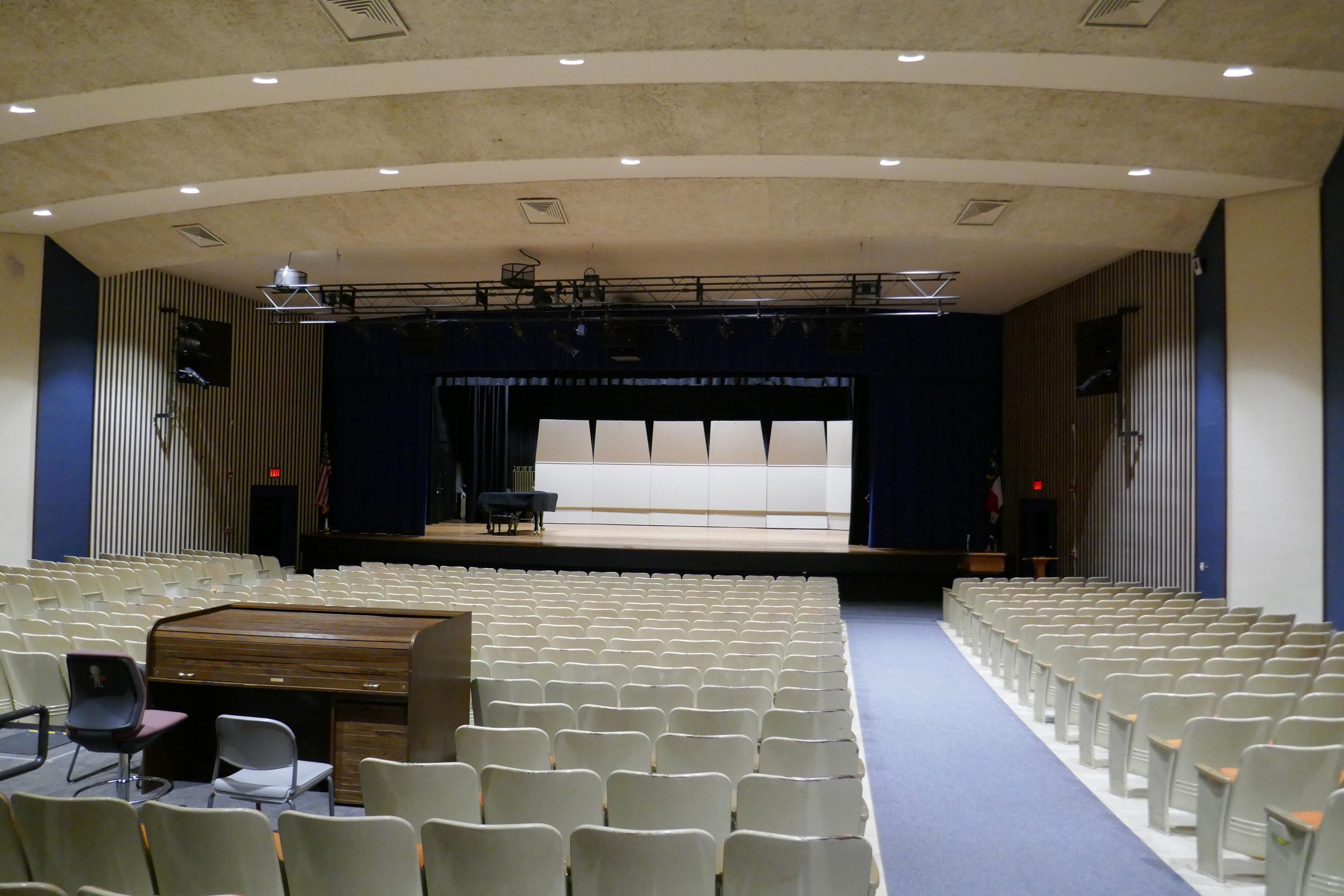
An auditorium before a major renovation. The author witnessed a piano recital in this room with perhaps 100 attendees spread all around the seating which doesn’t create the same excitement as a smaller space sized closer to the expected audience. A new, more intimate space is being constructed for small scale recitals. (Photo by author)
“Don’t build a church for Easter Sunday.” Perhaps it is an old saw, but it really is important to think about the audience size for a performing arts space very early in planning a venue. Even more important is to be realistic, considering all the performance types planned and what can be supported.
“Don’t build a church for Easter Sunday” is pretty simple. There are two times a year when churches have the greatest attendance and those times aren’t hard to figure out. If one is building a new church, does it make sense to build it for the largest congregation that only appears two times a year? Maybe the answer is yes, “we expect to grow into it” for the other Sundays. Regardless, one must ask, how does the space feel the other 50 weeks of the year?
The same can be said for performing arts spaces, and perhaps it is complicated by financial imperatives. Is this a public or private institution? For profit or not? What is the business case for the project? Depending on the funding source and supporting organization, the return on investment for a larger space must be worth it. The math has to math, as they say.
Many questions are answered in feasibility and market studies. What does the organization want to do, what does the business model look like, and can it draw the needed crowds? By doing an early study, an organization can right-size their project to meet their needs. Pure economics will drive the decisions for many facilities, such as those hosting popular music. They must consider costs to operate and what acts the venue can draw with a large enough audience on a sufficient number of days during the year.
It may be easy to say, “We want a 1,500-seat theatre.” But it is important to understand the “why” behind that statement and then to validate the answer.
One place where the over-sized theatre or auditorium can be found is in educational facilities where there are different priorities. School administrators are not prioritizing audience size as a way to make money let alone break even. Often it seems an administrator will say they want an auditorium that can accommodate all four classes in a high school for assemblies, or at least one year’s class. Sometimes it is about holding convocations or graduations. There is some sound reasoning here, but does it make sense for the other days and events in the year? Assuming graduation or an all-school assembly could reach 1,200 or 1,500 (or more) participants, is that the right size auditorium for all the other events the space will accommodate?
This becomes the question and should be a discussion topic. Will such a large space support choir concerts where the attendance is half of capacity or less? Music programs may be big draws in many schools, but will the attendance at those shows justify a larger room? Theatre or drama often expect to use these spaces, but if that department draws a fraction of the total capacity in a big auditorium, how does that feel? Is it supportive of young performers to see their families and a few friends in a sea of empty seats?
Sometimes the answer is to build a different space to handle smaller drama events, smaller lectures, recitals, and the like. This can be a better solution, because performers can feel the audience, and performing to a nearly empty barn does not inspire confidence. This is one reason that black box or studio theatres are an excellent choice; such a smaller space allows performers to learn, experiment, and grow in a more comfortable environment. In education it is important to support young performers. Professionals also want and need to connect to an audience. But a studio space is rarely a suitable substitute for a traditional proscenium space for many event types. This should all be part of the discussion.
Another option is to build a single, smaller multipurpose venue and add shows to a run. There are costs involved, and for some events (i.e. graduation), it may not be practical. It is worth having a discussion of the pros and cons between the stakeholders and planners. More dates may offer the flexibility to extend a performance run to suit the audience size without building more space than can be supported for other dates during the year.
Is an alternate space a better choice for large events? Perhaps that is the stadium for graduation, or in the gymnasium or field house when the weather demands. With careful planning those spaces can be made more comfortable and accommodate those high capacity events. Doing so may make the auditorium work better for the other 99% of events.
Of course, every square foot of construction adds cost, and assembly spaces are expensive to begin with. In designing buildings, budget always comes up. It is common for a project to start with grand plans for a large capacity auditorium, only to find it on a severe seat count diet by the time the project completes early design phases. The space needed for each seat and circulation can only be squeezed so much before building codes and audience comfort suffer, so seat count reduction is a common remedy. For better or worse.
In the end it is important to put some thought into how many seats are really needed, and the theatre planner should help lead the discussion. An analysis or some understanding of the real use of the auditorium is needed. Consider the full range of event programming, as well as the audience and performer experience. Sometimes the answer is to build larger; sometimes the better answer is to build smaller.
With apologies to Field of Dreams, “If you build it, they will come” may not always be the best strategy. Do the homework. You will be happier in the end.
By Paul Sanow, ASTC
Disclaimer: Any views or opinions expressed in this article are solely those of the author and do not necessarily represent those of the American Society of Theatre Consultants. This article is for general information only and should not be substituted for specific advice from a Theatre Consultant, Code Consultant, or Design Professional, and may not be suitable for all situations nor in all locations.