
Sign-up for the ASTC Newsletter!

    • Home
    • About ASTC
      • What is a Theatre Consultant?
      • Why an ASTC Member
      • FAQ
      • Officers & Liaisons
      • ASTC Programs
    • Members
      • ASTC Membership Roster
      • ASTC Fellows
      • Prospective Members
      • ASTC Membership and Application FAQs
    • Newsletters
    • Publications
      • Position Papers
    • ASTC News
    • Venue Challenge
    • Contact
      Sign-up for the ASTC Newsletter!

      • Home
      • About ASTC
        • What is a Theatre Consultant?
        • Why an ASTC Member
        • FAQ
        • Officers & Liaisons
        • ASTC Programs
      • Members
        • ASTC Membership Roster
        • ASTC Fellows
        • Prospective Members
        • ASTC Membership and Application FAQs
      • Newsletters
      • Publications
        • Position Papers
      • ASTC News
      • Venue Challenge
      • Contact
        Sign-up for the ASTC Newsletter!

        • Home
        • About ASTC
          • What is a Theatre Consultant?
          • Why an ASTC Member
          • FAQ
          • Officers & Liaisons
          • ASTC Programs
        • Members
          • ASTC Membership Roster
          • ASTC Fellows
          • Prospective Members
          • ASTC Membership and Application FAQs
        • Newsletters
        • Publications
          • Position Papers
        • ASTC News
        • Venue Challenge
        • Contact
          Sign-up for the ASTC Newsletter!

          • Home
          • About ASTC
            • What is a Theatre Consultant?
            • Why an ASTC Member
            • FAQ
            • Officers & Liaisons
            • ASTC Programs
          • Members
            • ASTC Membership Roster
            • ASTC Fellows
            • Prospective Members
            • ASTC Membership and Application FAQs
          • Newsletters
          • Publications
            • Position Papers
          • ASTC News
          • Venue Challenge
          • Contact

          • Home
          • About ASTC
            • What is a Theatre Consultant?
            • Why an ASTC Member
            • FAQ
            • Officers & Liaisons
            • ASTC Programs
          • Members
            • ASTC Membership Roster
            • ASTC Fellows
            • Prospective Members
            • ASTC Membership and Application FAQs
          • Newsletters
          • Publications
            • Position Papers
          • ASTC News
          • Venue Challenge
          • Contact

          • Home
          • About ASTC
            • What is a Theatre Consultant?
            • Why an ASTC Member
            • FAQ
            • Officers & Liaisons
            • ASTC Programs
          • Members
            • ASTC Membership Roster
            • ASTC Fellows
            • Prospective Members
            • ASTC Membership and Application FAQs
          • Newsletters
          • Publications
            • Position Papers
          • ASTC News
          • Venue Challenge
          • Contact
          • Home
          • ASTC News
          • Theatre Consultants
          • Did You Know – The Importance of Excellent Audience Sightlines

          Did You Know – The Importance of Excellent Audience Sightlines
          Published by Staff on June 16, 2026
          Categories
          • Theatre Consultants
          • Theatre Design - Did You Know?
          • Theatre Design Article
          Tags
          Glazer-Hall-sightline-section

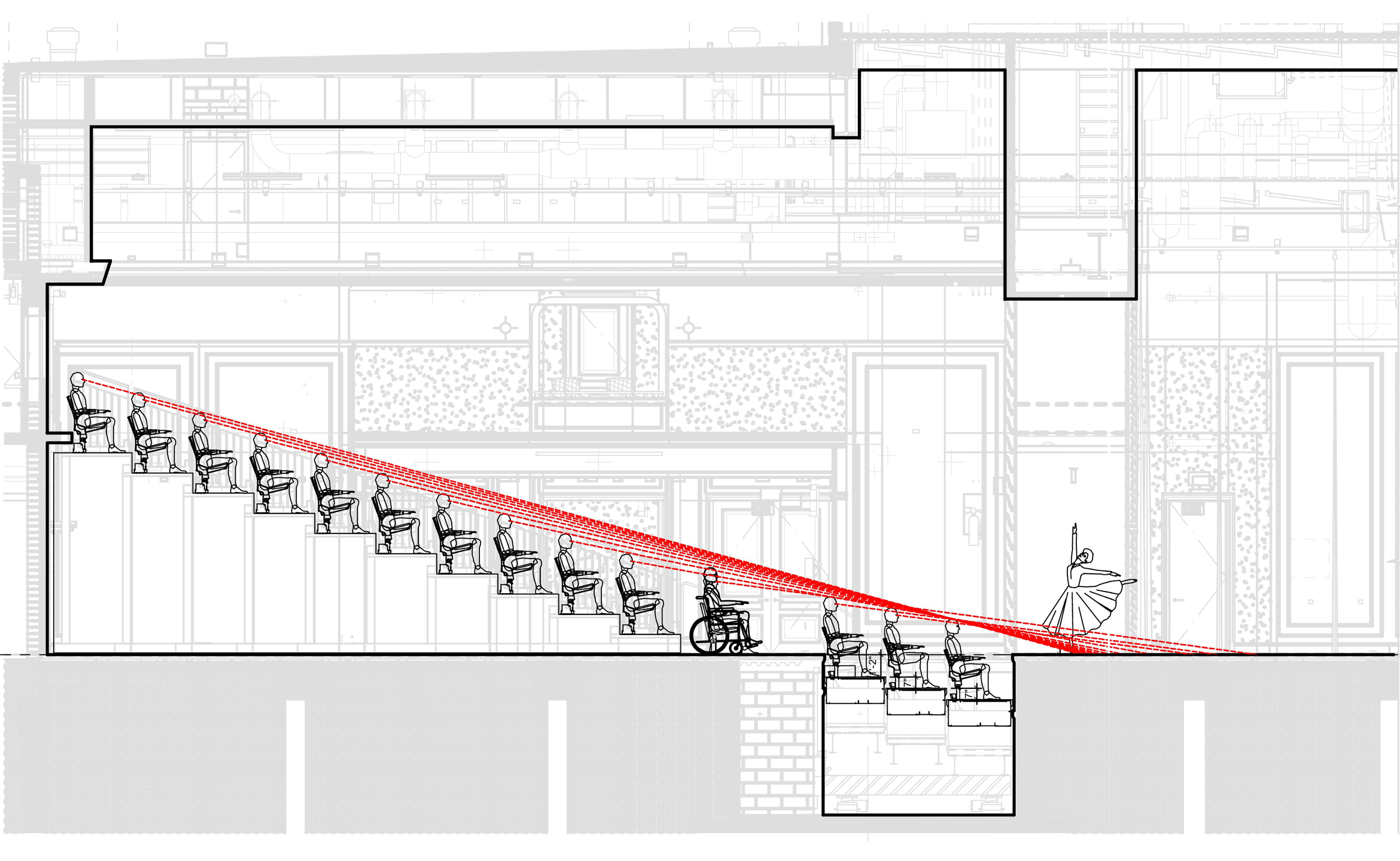
          Sightline section of a multi-use performance hall when used for dance where visibility of the performers’ feet is critical. Glazer Hall – Palm Beach, FL. (Drawing by Kurt Wehmann, ASTC)

          The ability of audience members to see the performers on stage is a critical element of auditorium design, whether the auditorium is designed for theatre, music, opera, or dance.  ASTC theatre consultants are typically responsible for integrating optimum sightlines into both new and renovated spaces.  With new construction, the opportunities are straightforward.  With renovations and adaptive reuse projects, the challenge is to achieve effective sightlines within the existing structure and volume.  In all cases, ADA compliant seating must also have clear sightlines to the stage and the performers.

          Sightline requirements change depending on the primary use of the performance hall.  For instance, concert and recital halls often allow a shallow seating rake and perhaps a higher stage than might be found in other types of venues as the musical art form evolved from flat-floor, “shoebox” shaped rooms. A theatre for dance might be designed so that audience members are able to see choreographed dance patterns on the stage from a higher vantage point.  The adaptive reuse of former cinema spaces and church sanctuaries both require significant adjustments of the existing sightlines because the view angle of the cinema was previously to an elevated projection screen and the view angle of the sanctuary seating was to an elevated pulpit or altar.  Whether dance, music, or theatre, the audience wants to see the dancer’s feet, Yo-Yo Ma’s bow work, and the bodies down center stage at the end of a Shakespeare history play.

          Glazer-Hall-dance-performance-rendering

          Architect’s rendering of the performance hall in dance mode. Glazer Hall – Palm Beach, FL. (Rendering provided courtesy of Spina O’Rourke + Partners)

          Popular music venues, especially those with large, flat-floor areas for a standing audience, have very different sightline requirements than a conventional theatre.  Stage floors for these events can be up to five feet above the standing area to allow the audience to have a full view of the performers.  This audience-to-stage relationship requires the provision of elevated seating locations for audience members in wheelchairs and with other mobility issues.  Balconies and VIP boxes add other important sightline considerations to the mix.

          Regardless of whether the project is new construction or a renovation, ASTC consultants are mindful that different performance types require different sightline solutions.  Optimum sightlines not only allow the audience to see the stage, at best they also encourage the audience to forge all-important visceral and emotionally memorable connections to the performance they are experiencing.  And that’s our goal!

          By Robert Long, FASTC and Kurt Wehmann, ASTC

          Disclaimer: Any views or opinions expressed in this article are solely those of the author and do not necessarily represent those of the American Society of Theatre Consultants.  This article is for general information only and should not be substituted for specific advice from a Theatre Consultant, Code Consultant, or Design Professional, and may not be suitable for all situations nor in all locations.

          Share

          Related posts

          May 20, 2026

          Jules Fisher to Receive Tony Lifetime Achievement Award


          Read more
          April 13, 2026

          ASTC – USITT Renovation Challenge 2027 Applications Now Available


          Read more
          April 8, 2026

          Len Auerbach, FASTC Honored with USITT Distinguished Achievement Award in Architecture


          Read more
          ✕

          Recent Posts

          • Did You Know – The Importance of Excellent Audience Sightlines
          • Jules Fisher to Receive Tony Lifetime Achievement Award
          • ASTC – USITT Renovation Challenge 2027 Applications Now Available
          • Len Auerbach, FASTC Honored with USITT Distinguished Achievement Award in Architecture
          • ASTC Announces New Fellows and Members at 2026 Annual Meeting
          • ASTC Seeks Participants for Performing Arts Restroom Study Survey
          • Designing Accessible Backstage and Onstage Spaces

          Categories

          © 2025 American Society of Theatre Consultants
          DMCA.com Protection Status
                       
          Member Login | Credits | Privacy | Terms