
Sign-up for the ASTC Newsletter!

    • Home
    • About ASTC
      • What is a Theatre Consultant?
      • Why an ASTC Member
      • FAQ
      • Officers & Liaisons
      • ASTC Programs
    • Members
      • ASTC Membership Roster
      • ASTC Fellows
      • Prospective Members
      • ASTC Membership and Application FAQs
    • Newsletters
    • Publications
      • Position Papers
    • ASTC News
    • Venue Challenge
    • Contact
      Sign-up for the ASTC Newsletter!

      • Home
      • About ASTC
        • What is a Theatre Consultant?
        • Why an ASTC Member
        • FAQ
        • Officers & Liaisons
        • ASTC Programs
      • Members
        • ASTC Membership Roster
        • ASTC Fellows
        • Prospective Members
        • ASTC Membership and Application FAQs
      • Newsletters
      • Publications
        • Position Papers
      • ASTC News
      • Venue Challenge
      • Contact
        Sign-up for the ASTC Newsletter!

        • Home
        • About ASTC
          • What is a Theatre Consultant?
          • Why an ASTC Member
          • FAQ
          • Officers & Liaisons
          • ASTC Programs
        • Members
          • ASTC Membership Roster
          • ASTC Fellows
          • Prospective Members
          • ASTC Membership and Application FAQs
        • Newsletters
        • Publications
          • Position Papers
        • ASTC News
        • Venue Challenge
        • Contact
          Sign-up for the ASTC Newsletter!

          • Home
          • About ASTC
            • What is a Theatre Consultant?
            • Why an ASTC Member
            • FAQ
            • Officers & Liaisons
            • ASTC Programs
          • Members
            • ASTC Membership Roster
            • ASTC Fellows
            • Prospective Members
            • ASTC Membership and Application FAQs
          • Newsletters
          • Publications
            • Position Papers
          • ASTC News
          • Venue Challenge
          • Contact

          • Home
          • About ASTC
            • What is a Theatre Consultant?
            • Why an ASTC Member
            • FAQ
            • Officers & Liaisons
            • ASTC Programs
          • Members
            • ASTC Membership Roster
            • ASTC Fellows
            • Prospective Members
            • ASTC Membership and Application FAQs
          • Newsletters
          • Publications
            • Position Papers
          • ASTC News
          • Venue Challenge
          • Contact

          • Home
          • About ASTC
            • What is a Theatre Consultant?
            • Why an ASTC Member
            • FAQ
            • Officers & Liaisons
            • ASTC Programs
          • Members
            • ASTC Membership Roster
            • ASTC Fellows
            • Prospective Members
            • ASTC Membership and Application FAQs
          • Newsletters
          • Publications
            • Position Papers
          • ASTC News
          • Venue Challenge
          • Contact
          • Home
          • ASTC News
          • Theatre Design - Did You Know?
          • Did You Know – Sound & Light Locks

          Did You Know – Sound & Light Locks

          Published by Paul Sanow on September 22, 2020
          Categories
          • Theatre Design - Did You Know?
          • Theatre Design Article
          Tags

          CLICK – <Blast of light> – THUNK. That’s the experience I have when I watch a show at my daughter’s high school theatre. The source of disturbance is another audience member entering or leaving the auditorium during a show. It does not have to be that way though.

          All performance spaces need sound and light locks. They are simple transition spaces between the public lobby areas and the auditorium. Some people might call them “vestibules”, but whatever the label, they have an important function. These spaces separate the sound and light of the public spaces from the controlled audience space. Some key features found in most sound and light locks:

          • Lower light levels reduce interruption for the audience watching a performance. The light inside should be bright enough to meet code requirements and for audience members to navigate but dark enough to avoid that dreaded light leaking into the seating area when the inner door is opened.
          • Two doors in series create a sound barrier from the outer, public spaces. Typically, the inner or audience-side door will have only push plates and gaskets to reduce noise. Locks, latches, and fire ratings should be at the outer, lobby-side doors.
          • The interior surfaces are commonly treated to be sound absorptive. Color may be subdued to reduce light reflectance when the door is open.
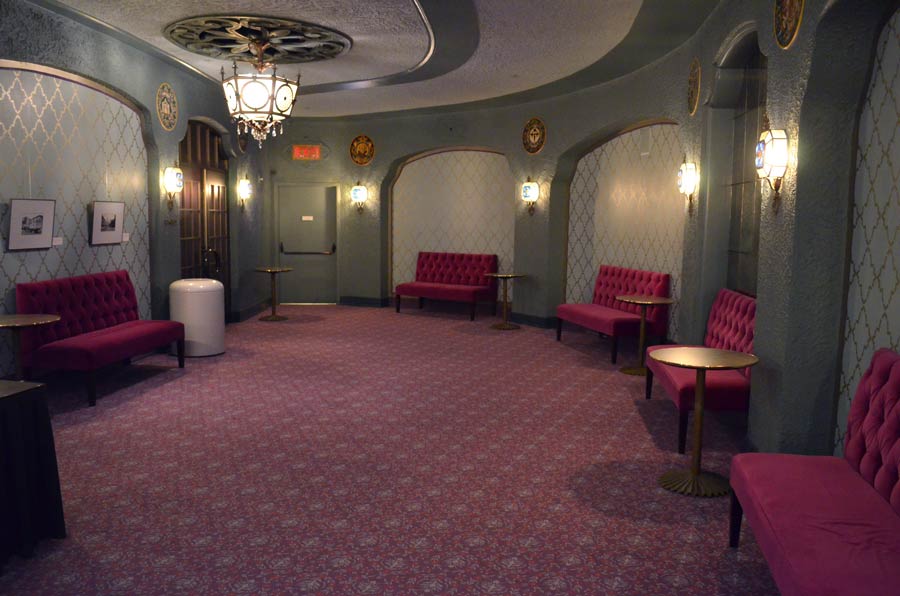
          The vestibule at the rear orchestra seating of the Capitol Theatre, Overture Center, Madison, WI. Most Sound and Light Locks are not very photogenic, but this area serves the purpose while also being a lounge area. Photo by Paul G. Sanow, ASTC

          These sound and light locks also suggest to the audience they are transitioning to a new space, and it may be time to be quiet, especially when entering an auditorium during a performance. Changes in materials can help signal the transition, including carpeting, colors, and other changes in appearance. These spaces also help one’s eyes to adjust to differing light levels while transitioning to and from the auditorium. Lighting should be on a separate dimmer, while also making sure there is emergency egress lighting during a fire alarm or loss of normal power.

          Sound and light locks are not just for audiences. They are important around stages and other entry points. Stage sound and light locks serve the same purpose, in this case separating a (sometimes) chaotic backstage from the stage. They are needed anywhere there is a transition between outer corridors and the performance space.

          Sound and Light Locks are some of the most important areas of a performance space. They can be as simple as a series of doors at each entry, with code minimum space between each door. In the past these were sometimes larger areas, with multiple doors and even furniture, drinking fountains, and other amenities. It doesn’t matter how the space is shaped, so long as it’s there.

          By Paul G. Sanow, ASTC

          Disclaimer: Any views or opinions expressed in this article are solely those of the author and do not necessarily represent those of the American Society of Theatre Consultants. This article is for general information only and should not be substituted for specific advice from a Theatre Consultant, Code Consultant, or Design Professional, and may not be suitable for all situations nor in all locations.

          Share

          Related posts

          March 9, 2026

          Designing Accessible Backstage and Onstage Spaces


          Read more
          December 17, 2025

          Why Terminate DMX Cables?


          Read more
          December 9, 2025

          Did You Know – Get with the Program?


          Read more
          ✕

          Recent Posts

          • ASTC – USITT Renovation Challenge 2027 Applications Now Available
          • Len Auerbach, FASTC Honored with USITT Distinguished Achievement Award in Architecture
          • ASTC Announces New Fellows and Members at 2026 Annual Meeting
          • ASTC Seeks Participants for Performing Arts Restroom Study Survey
          • Designing Accessible Backstage and Onstage Spaces
          • Why Terminate DMX Cables?
          • ASTC Forum Held In Charleston, SC

          Categories

          © 2025 American Society of Theatre Consultants
          DMCA.com Protection Status
                       
          Member Login | Credits | Privacy | Terms