Sign-up for the ASTC Newsletter!

    • Home
    • About ASTC
      • What is a Theatre Consultant?
      • Why an ASTC Member
      • FAQ
      • Officers & Liaisons
      • ASTC Programs
    • Members
      • ASTC Membership Roster
      • ASTC Fellows
      • Prospective Members
      • ASTC Membership and Application FAQs
    • Newsletters
    • Publications
      • Position Papers
    • ASTC News
    • Venue Challenge
    • Contact
      Sign-up for the ASTC Newsletter!

      • Home
      • About ASTC
        • What is a Theatre Consultant?
        • Why an ASTC Member
        • FAQ
        • Officers & Liaisons
        • ASTC Programs
      • Members
        • ASTC Membership Roster
        • ASTC Fellows
        • Prospective Members
        • ASTC Membership and Application FAQs
      • Newsletters
      • Publications
        • Position Papers
      • ASTC News
      • Venue Challenge
      • Contact
        Sign-up for the ASTC Newsletter!

        • Home
        • About ASTC
          • What is a Theatre Consultant?
          • Why an ASTC Member
          • FAQ
          • Officers & Liaisons
          • ASTC Programs
        • Members
          • ASTC Membership Roster
          • ASTC Fellows
          • Prospective Members
          • ASTC Membership and Application FAQs
        • Newsletters
        • Publications
          • Position Papers
        • ASTC News
        • Venue Challenge
        • Contact
          Sign-up for the ASTC Newsletter!

          • Home
          • About ASTC
            • What is a Theatre Consultant?
            • Why an ASTC Member
            • FAQ
            • Officers & Liaisons
            • ASTC Programs
          • Members
            • ASTC Membership Roster
            • ASTC Fellows
            • Prospective Members
            • ASTC Membership and Application FAQs
          • Newsletters
          • Publications
            • Position Papers
          • ASTC News
          • Venue Challenge
          • Contact

          • Home
          • About ASTC
            • What is a Theatre Consultant?
            • Why an ASTC Member
            • FAQ
            • Officers & Liaisons
            • ASTC Programs
          • Members
            • ASTC Membership Roster
            • ASTC Fellows
            • Prospective Members
            • ASTC Membership and Application FAQs
          • Newsletters
          • Publications
            • Position Papers
          • ASTC News
          • Venue Challenge
          • Contact

          • Home
          • About ASTC
            • What is a Theatre Consultant?
            • Why an ASTC Member
            • FAQ
            • Officers & Liaisons
            • ASTC Programs
          • Members
            • ASTC Membership Roster
            • ASTC Fellows
            • Prospective Members
            • ASTC Membership and Application FAQs
          • Newsletters
          • Publications
            • Position Papers
          • ASTC News
          • Venue Challenge
          • Contact
          • Home
          • ASTC News
          • Theatre Consultants
          • Did You Know – Stage Directions

          Did You Know – Stage Directions

          Published by Paul Sanow on January 5, 2019
          Categories
          • Theatre Consultants
          • Theatre Design - Did You Know?
          • Theatre Design Article
          Tags

          By Paul G. Sanow, ASTC

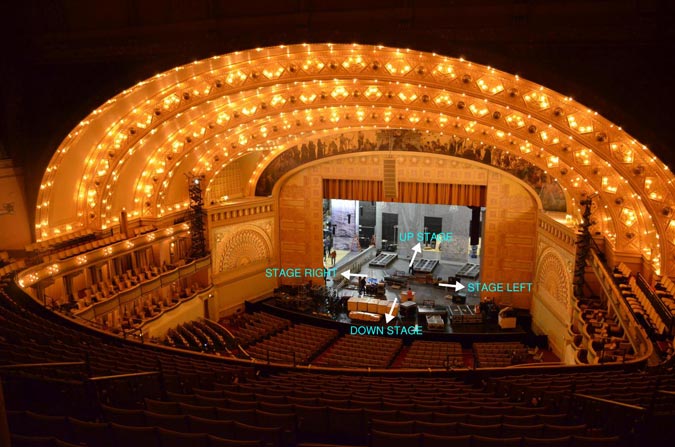
          Auditorium Theatre in Chicago during load in. (Photo by Paul Sanow, ASTC)

          Auditorium Theatre in Chicago during load in. (Photo by Paul Sanow, ASTC)

          As theatre consultants we must be able to speak the language of both theatre and construction. While most of the time we can talk about locations in a theatre using cardinal directions, we are often more comfortable using stage directions. They are the same for virtually every performance space, no matter where the building is sited.

          Stage Left and Stage Right are simple and always from the point of view of the performer. When a performer addresses the audience directly, Stage Right is to the performer’s right, and Stage Left to their left. Performers, technicians, and really everyone immersed in this work know this reflexively. Personally, I can’t often recall the direction of north in a windowless theatre, but I know where to find Stage Right, with my eyes closed.

          Up Stage and Down Stage are a bit trickier, yet again well understood within the industry. In the past stages were raked or sloped in many theatres, with the lower portion being the front of the stage, and rising toward the back. For a performer standing at the center of the stage looking at the audience, if they walk forward, they are moving “down stage”. Raked stages were used to improve sight lines for the audience, and the slope could be substantial. There are some theatres which still have a raked stage such as Ford’s Theatre in Washington, D.C, though that slope is fairly gentle at less than one half inch per foot. Raked stages are still used to this day as a scenic concept, typically built up over the flat, fixed stage, contributing to a natural vanishing point for scenery designed with “forced perspective”, creating a greater sense of depth.

          These directions can also be combined, so a performer moving down stage right is moving diagonally toward the audience and stage right. Stage Directors, choreographers, designers and technical staff also use these terms almost exclusively.

          So now you know what we are thinking when we say, “Please move that box three feet stage left”.

          Virtually every theatre student receives a humorous take on stage directions in some form early in their education. Before the internet, it was often a third-generation photocopy. No one knows who wrote it, but every bit is true. Theatres can be confusing and here’s one reason why.

          THEATRE LOGIC

          Author Unknown – Contributed by Andrew Gibbs, ASTC

          • In is down, Down is front.
          • Out is up; Up is back.
          • Off is out, On is in, and, of course, Right is left and Left is right.
          • A Drop should not, and a Block and Fall does neither.
          • A Prop does not, and a Cove has no water. (Unless the building is flooding.)
          • Tripping is OK.
          • A Running Crew rarely gets anywhere.
          • A Purchase Line will buy you nothing.
          • A Trap will not catch anything.
          • A Gridiron has nothing to do with football.
          • A Strike is work; in fact, a lot of work.
          • A Green Room usually is not.
          • And now, following this review of theatre logic, “Break a Leg!”
          Share

          Related posts

          April 13, 2026

          ASTC – USITT Renovation Challenge 2027 Applications Now Available


          Read more
          April 8, 2026

          Len Auerbach, FASTC Honored with USITT Distinguished Achievement Award in Architecture


          Read more
          March 27, 2026

          ASTC Announces New Fellows and Members at 2026 Annual Meeting


          Read more
          ✕

          Recent Posts

          • ASTC – USITT Renovation Challenge 2027 Applications Now Available
          • Len Auerbach, FASTC Honored with USITT Distinguished Achievement Award in Architecture
          • ASTC Announces New Fellows and Members at 2026 Annual Meeting
          • ASTC Seeks Participants for Performing Arts Restroom Study Survey
          • Designing Accessible Backstage and Onstage Spaces
          • Why Terminate DMX Cables?
          • ASTC Forum Held In Charleston, SC

          Categories

          © 2025 American Society of Theatre Consultants
          DMCA.com Protection Status
                       
          Member Login | Credits | Privacy | Terms